“The Earth does not belong to us, we belong to the Earth” – Chief Seattle
Murchison Falls National Park lies at the northern end of the Albertine Rift Valley, where the sweeping Bunyoro escarpment tumbles into vast, palm-dotted savanna. First gazetted as a game reserve in 1926, it is Uganda’s largest and oldest conservation area, hosting 76 species of mammals and 451 birds.
The northern section of the park contains savanna and borassus palms, acacia trees and riverine woodland. The south is dominated by woodland and forest patches.
The mighty cascade drains the last of the river’s energy, transforming it into a broad, placid stream that flows quietly across the rift valley floor into Lake Albert. This stretch of river provides one of Uganda’s most remarkable wildlife spectacles. Regular visitors to the riverbanks include elephants, giraffes and buffaloes; while hippos, Nile crocodiles and aquatic birds are permanent residents.
The savanna-dwelling patas monkey is only found here and in Kidepo Valley National Park.
The Murchison Falls-where the Nile squeezes through an 8m wide gorge and plunges with a thunderous roar into the “Devil’s Cauldron”Lovely landscapes with these gentle giants and their other ungulate friends. The Giraffe on a Mission – wonder, what they think and why they do what they do?It is a treat to watch a tower / journey of giraffes ; I call them wild mobile towers (pun intended).A harem of female Ugandan KobesThe Alpha Male (Ugandan Kobe) and other young contenders nearbyJackson’s Hartebeest : also known as kongoni, Hartebeests are a large African antelope. Jackson’s Hartebeest is one of the 8 sub-species. These antelopes can weigh upto 200 Kgs. Males and females, both have the horns. It has a particularly elongated forehead and oddly shaped horns, short neck, and pointed ears. Form herds of 20 to 300 individuals. Once, found in abundance, their numbers have declined for all reasons human. Oribi : Male in the foreground. Horns distinguish the males from the females. It is a small antelope found in eastern, southern and western Africa. The oribi reaches nearly 50–67 centimetres (20–26 in) at the shoulder and weighs 12–22 kilograms. Typically diurnal, the oribi is active mainly during the day. Small herds of up to four members are common; males defend their group’s territory, 25–100 hectares (62–247 acres) large. Typically a grazer, occasionally engages in browsing.The Grey Kestrel. An African bird of prey belonging to the falcon family ‘Falconidae‘. Its shorter wings help differentiate it from very similar Sooty Falcon, whose wing tips almost reach the tail end at rest. It is a crepuscular bird, most active at dawn and dusk. It generally hunts from a high perch but occasionally hovers. It feeds mainly on insects, lizards and small mammals including bats, also hunt other birds, worms and amphibians. Prey is usually caught on the ground.Denham’s Bustard : A large bustard, It is a species of open ground, including agricultural land, grassland, flood-plains and burnt fynbos. It is resident, but some inland populations move to lower altitudes in winter. The common names for this species refer to the English explorer, Major Dixon Denham.Also known as Stanley bustard or Stanley’s bustard. The male is 9 to 10 kg and 100–116 cm, while the female is smaller.The Abyssinian ground hornbill or northern ground hornbill is an African bird, found north of the equator, and is one of two species of ground hornbill. It is the second largest species of African hornbill, only surpassed by the slightly largerSouthern Ground Hornbill. Above picture shows the male with a red collar and the female with a purely blue neck.A Red Throated Bee Eater. What a delight to see this bee-eater. The red-throated bee-eater has a wide distribution across tropical Africa, its range extending from Senegal and Gambia in the west to Uganda, southern Sudan, and Ethiopia in the east. The red-throated bee-eater is a colonial species, nesting in groups and remaining in the nesting area all year round. The nests are tunnels, excavated before the ground dries after the rainy season, the colony having up to about fifty nests. The diet of these birds consists mostly of honey-bees and stingless bees, as well as other insects.The short-toed snake eagle (Circaetus gallicus), also known as the short-toed eagle, is a medium-sized bird of prey. Spread over a wide range. This is an ‘Old World’ species found throughout the Mediterranean basin, into Russia and the Middle East, and parts of Western Asia, and in the Indian Subcontinent and also further east in some Indonesian islands.A Common Genet. An agile, omnivorous, opportunistic animal which lives on ground as much as on the trees. It also feeds on plants and fruits occasionally. Normally solitary, except while mating and with off-springs. normally has a litter of five. Was lucky to find this one looking around leisurely along the path. Stayed around for 15 to 20 minutes. The eureka moment at 0630 h, we were the first ones to enter the reserve. found six to eight young lionesses resting on the track (the grass was all wet with rain). The moment they heard the vehicle, they started to move into the grass. Lucky that these two stayed long enough for me to pick up the camera.One of the lionesses – thinking !!Two more lionesses from the same group as above.The best ever sighting of a leopard for me. It was a treat to see this young leopardess leap out of the tall grass and onto the bark of this tree. It was fascinating to see all the motions and actions including pulling at the bark to clean the claws. It was the most exciting times to see this Leopardess. Young, primed and promising !!The queen of the grasslands !!Looks squarely into my eyes. The gentlest of the giants came along. and then I saw the most heart wrenching scene – the young one was trying to push the empty plastic bottle down its throat. The elders were oblivious or had no clue about it. I watched helplessly and my query to our guide also brought in a quiet response – there is nothing that we can do about it.Guess, my prayers were answered (quickly). The young one dropped the bottle and moved on. Another pachyderm : A young male alerted by our presence !!
Murchison Falls national reserve was definitely a great place to visit with herds of wild animals still moving about freely. However, one can see the roads and tracks being built and cutting across the paths of these gentle creatures, who know nothing of human compulsions. I only hope the traffic remains within limits and there is enough for the man and the animals to survive together.
Lets persevere and preserve whatever little is left of our planet !!
A broad field collection of Indian birds—from familiar garden visitors to birds of prey and the elusive owls of forests, wetlands and open country.
Bird portraits
“Wherever there are birds, there is hope.” – Mehmet Murat Ildan
Ranking amongst top 10 most biodiverse countries (yeah, be proud of it and protect it), India is home to about 1211 species of birds of splendid variety, shapes, colors and equally diverse habits and habitats.
Here are some observations without going too far or exclusive to find them, except a few. Bear with the poor quality of some pictures, I am basically a birder trying to learn photography both for its own charm and keeping records.
If you have any queries / suggestions / feedback – please leave them in the comments. Will revert.
Tailor Bird : Bamboo Fence and Lantana. Clicked at home. Saugor, MP, India 2013. Tailor birds stich leaves together to build their nest – that is why the name !
Red Wattled Lapwing (Titihiri in Hindi). Lays a clutch of 3-4 eggs on a shallow pit on the ground and there after defends the territory with a fierce force. Doesn’t hesitate in attacking even humans wandering too near its nest.
Yellow Wattled Lapwing: Not as common as its cousin Red Wattled Lapwing.
A male Paradise Flycatcher. Grow upto 50 cm tip to tail. Fully mature adult males turn white. In flight, the tail follows the bird like a ribbon in flow. Collects spider web to strengthen the nest.
Female Paradise Flycatcher. Does not have the long tail like male and stays in this colour throughout. Both parents share the parenting duties.
Male Indian Magpie Robin. Female is dull grey. One of the most common songster – very melodious calls. Common around human habitats.
Crimson Breasted Barbet aka Coppersmith. Named Coppersmith as its repetitive high pitch call notes are similar to a coppersmith striking metal with a hammer (tunk tunk tunk….). The female excavates a hole in the tree trunks / branches for making a nest.
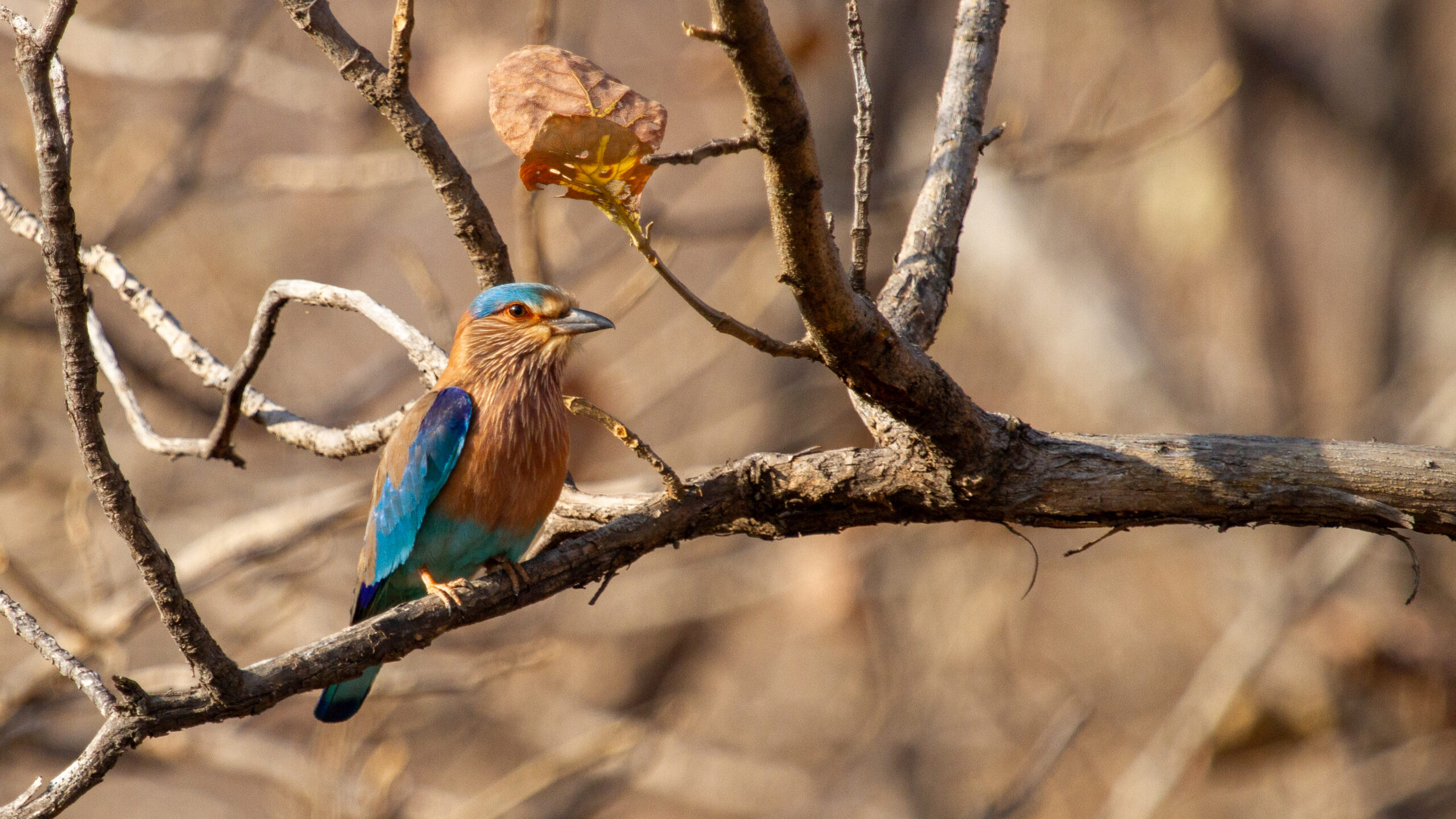
Indian Roller / Neelkanth. Earlier name Blue Jay. Beautiful bird, specially in flight. Sadly, owing tomythology, many are captured during festive season of Dushhera as people consider it lucky to see one. Hence, they are caught and paraded for a fee outside temples. Most end up dead due to starvation. Rollers eat insects and their human captors try to feed them Rice / Roti.
Brown Fish Owl. 55 – 60 cm. A big owl, this one was sitting pretty in the shade over a stream flowingbelow. Bandhavgarh Tiger Reserve, Madhyapradesh. 2016.
A Collared Scops Owl. Mediun size. It took my wife and me more than an year to locate this beauty. We would hear its extremely soft call – a single ‘wut’ and wonder, what is it and where is it? Absolutely thrilled to discover it finally. Witnessed the pair raise a family of two chicks.
A Jungle Owlet. Common in India, found in habitats ranging from scrub forest to deciduous and moist deciduous forests. Active during dawn and dusk, known to bask in sunlight as seen here. Shot near Dharamsala, 2017.
Spotted Owlet. Smaller in size. One of the most common owlets found in the country. Commonly seen fluttering about and calling around the human habitats during the dusk. Notice the difference between the Jungle and Spotted Owlet.
Virditer Flycatcher. An exquisite, old world bird with unique colours and equally unique metallic calls. Female, slightly dull and displays some patterns too. Clicked in our house garden, Saugor, Madhya Pradesh.
Do NOT assume that this is a Virditer female. This looks similar, but is a different bird altogether. This is a Blue Rock Thrush.
An Indian Jungle Nightjar. Nocturnal, sleeping in a typical habitat during the day, blending in effortlessly with the branch below. Not easy to spot, especially during daylight hours due to their excellent camouflage pattern. Bandhavgarh, 2016.
Indian Skimmer. Lower mandible is bigger than upper, used to skim the water as the bird s flies low over the water. Classified as Endangered list by IIUCN. Clicked near Chambal River, South of Agra.
A Eurasian Spoonbill. Feeds by wading in shallow waters, moving its broad bill side ways, snapping it shut if any small fish, insect or crustacean comes in contact. Breeds in reed beds. Clicked on the banks of River Chambal, South of Agra. 2016.
A small Bee-Eater. Catches insects (specially bees) while on the wing, displaying swift maneuvers and acrobatics. Beats the insect dead on the branch / wire before swallowing it. Nests in shallow holes excavated in mud walls. Common in India.
Crimson Sunbird. A medium sized sunbird found in the Northern and NE parts of India. Spreads upto Indonesia. Female is dull olive-yellow overall with brighter underparts. Clicked in Palampur, HP, 2017.
A Tickell’s Blue Flycatcher (male). Female is less intensely coloured. Found all over India. Very pleasant calls (metallic clinks at times). Clicked in home garden. It visited regularly to drink from the water bowl. Saugor, Madhya Pradesh. 2014.
A Purple Sunbird (male). Female is dull brown in colour. Male turns Purple during breeding season. A commoner around gardens and human habitats. Found all across the country.
A Yellow Breasted Greenfinch (male). Female is duller in colours. Seen in pairs / flocks. Distributed along the Himalayan foothills in Northern to NE India. Clicked in Palampur, 2017.
A Common / Siberian Stonechat. Quite like European Stonechat. Clicked in Manali, Himachal Pradesh.
Special Mention : A male Shrike (left in the image) is feeding a cuckoo chick considering it as his own. Notice the chick has grown larger than its foster parents. We have all heard about cuckoos engaging in parasitic breeding i.e., they lay their eggs in other species nests. This is the evidence. For me personally, this was thrilling, I saw the (poor) Shrike pair constantly working to satisfy this chicks hunger, which is at least 3 times their size. Another interesting fact, different species of cuckoos, target different birds to raise their young. They all have different size / shapes / colours of the eggs which match their targets. Most cases, the cuckoo females, just toss out the host’s eggs and lay their own in hosts nests. You can see the unaware victim performing its parental duty in full earnst. I sometimes wonder that there is nothing un-natural in Nature (its all part of the game / circus called Life). PS – I wish I could remove that branch, but then the Shrike would have fallen down 😉
Hope you liked the short exposure to our own natural heritage. I intend covering Indian Birds of Prey in a separate chapter – they definitely deserve a special post.
Happy birding !!
Birds of prey
“when they prey, others pray” – birdingjo
Fierce, powerful, and ruthless rulers of the skies, the raptors have long fascinated humans. History is replete of records displaying the reverence these birds of prey have attained over thousands of years in all parts and cultures of the world.
India too is home or a pit stop for many a raptors. Great variety and diversity is found all across the country. Here is a humble collection of a few that my friends and I have been lucky to observe and capture some memories.
Sitting pretty, in the falling Sun, a Black Shouldered Kite. Mhow, MP, 2016.
A Brahminy Kite : generally found near water bodies. Found in Indian subcontinent, Southeast Asia and Australia. It is primarily a scavenger, feeding mainly on dead fish and crabs, especially in wetlands and marshland,[13] but occasionally hunts live prey such as hares and bats. In Hinduism, it is considered as the contemporary representation of Garuda, the sacred bird of Vishnu.
A Common Kestrel (male). One of the best shots I have ever seen. Clicked by an ace birder and photographer Rohit Gupta. The story behind the shot in his words “One of my favourite bird images since I spend almost an hour taking this series of images, when I stumbled upon this Common Kestrel in Dec 2010, on the banks of the Chenab in Akhnoor. The bird was perched on this boulder and had finished a prey, it had been feeding on. I was in a military gypsy & stayed inside, the bird was also fairly bold & did not fly away. This firmed my belief that birds are most confiding if you approach them in a vehicle and till they aren’t exposed to the familiar human silhouette of a head on shoulders (A birding hat is worn to break that silhouette when on foot and approaching a bird)!”
Crested Serpent Eagle. Saw it sitting on a branch. I was still fumbling with my camera when it swooped down on the ground – on I did not know what. On crawling closer, found it clobbering this snake. It started swallowing it head first, but on detecting my presence, flew off with its catch into the thickets. Clicked at Saugor, MP, 2014.
A White Bellied Sea Eagle. The female is slightly larger than the male, and can measure up to 90 cm (35 in) long with a wingspan of up to 2.2 m (7.2 ft), and weigh 4.5 kg. Mainly feeds on fish, but also opportunistic, it does’nt mind carrion. Distributed along coastal areas from India to Australasia. Clicked in Andaman Islands, India, 2016.
White Eyed Buzzard. The most common buzzard with distinctive white iris and dark mesial stripe. Widely distributed in South Asia, throughout India in the plains and extending up to 1000 m in the Himalayas. Resident in Iran, Pakistan, Nepal, Bangladesh, and Myanmar. Feed mainly on locusts, grasshoppers, crickets, and other large insects, as well as mice, lizards, and frogs. Occasionally, hunts larger prey as hare. Barmer, Rajasthan, 2013.
An Oreintal Honey Buzzard. A slender raptor with a smaller head resembling a pigeon (though larger). Two species are found in India, One resident and another migratory. Specialist hunter, it primarily feeds on the larva of wasps and bees, honey and wax. Also feeds on other insects. Contribution by Gaurav Kamboj. Clicked in Faridkot, Punjab. Jan 2021.
Bonelli’s Eagle – Eagles are among the largest birds of prey & the apex predator in the avian world. 60 different species occur in the Eagle family worldwide, of which12 are found In India. Large hooked beaks for tearing prey, strong muscular legs, powerful talons & sharp eyesight are characteristic of Eagles. In the image, the uncommon Bonelli’s Eagle can be seen perched at Middle Lake, College of Military Engineering, 24 Jan 21. In culture & religion, besides flight, eagles are symbolic of power, vision, freedom, grace & heraldry, and have also given rise to idioms such as eagle eyed, legal eagle, etc. The national bird of the US is an eagle – a Bald Eagle. Closer home, the Eagle adorns the formation signs of many a divisions in our Army. In fact, one of the largest and highest flying eagles – the magnificent Golden Eagle forms the crest of the Indian Air Force too! . Image and write up – Rohit Gupta
Tawny Eagle, a large raptor from the family of booted eagles (see the covered legs). Distributed in African, Indian sub-continent and occasionally Southern Middle East. Avid Hunter, mostly takes down live prey but also scavenges. Prey is mostly ground based, including small reptiles, rodents, hare, small deer / young gazelles, sometimes birds in flight like flamingoes. Reported to be facing a population decline. Clicked outside Bikaner, Rajasthan, 2012.
Another large raptor, Steppe Eagles also belong to the booted eagles. Widely distributed (see inset map, credits – Wikipedia), it migrates long distances during winters. Different hunting and dietary habits in breeding and non-breeding ranges. Actively hunts ground squirrels and mammals like marmot sin the former, while it is lazier in the latter and preys on insects, scavenges and occasionally hunts live prey. Credits : Gaurav Kamboj. Clicked in 2019, at Lansdowne, Uttarakhand, India.
A Peregrine Falcon. One of the most widely distributed raptor, It can be found anywhere in the world except New Zealand (Islands). At top speeds of 325 kmph, it is the fastest bird and fastest member of the animal kingdom. A typical bird eating raptor, hunts by swooping down on its prey at high speeds. Sometimes hunts, small mammals, reptiles or insects. A favourite as a falconry bird, due to its skills & hunting prowess. Picture contributed by Akash Chinche.
Shikra – The Shikra is a small hawk & the apex predator in the urban avian world. Derived from the urdu word Shikari meaning hunter, the name is an embodiment of the bird’s chief talent! In pre-independence era, this bird was a favourite amongst falconers, & used for hunting smaller birds. Though illegal now, falconry is still practised in Pakistan & the Arab world. A common resident of Indian subcontinent, in the picture above, it is seen perched silently on a leafy tree, in wait for prey or soaring overhead with its typical sequence of rapid wing flaps and glide. The bird in the image, with a yellow iris, is an adult female while the male is a tad smaller & has a red iris. Its prey comprises lizards, small birds & mammals, often taken by surprise from a concealed perch. I observed a pair closely, build a nest on a eucalyptus tree & raise two fledglings, and the female dive-attacked me. Well, that birding tale is for another day! Image taken at College of Military Engineering, Pune, Jan 2021
A Shikra Juvenile. See the three different avatars of the same bird – a deadly hunter and a thriving bird. Commonly found living amongst the humans even in the din of busy metro-cities like Delhi and Bengaluru. This one was clicked in Saugor, MP, 2014.
Amur Falcons make special appearance in India – we must be conscious, lest they too become a part of history like the Siberian Cranes (Amur is hunted for food in Nagaland). See the migration route inset. It breeds in Northern China / South-Eastern Siberia, migrates over Indian Subcontinent, Arabian Sea to spend winters in Southern Africa. Migrates on a broad front and wanders about, have been observed in UK, Italy and other parts of Europe. It primarily feeds on insects, takes other birds and small mammals sometimes. Contribution by Akash Chinche.
Shaheen, a sub-species of Peregrine Falcon. Medium sized raptor, distributed from South Eastern Iran, Afghanistan, Indian Subcontinent to Myanmar. Earlier a common bird, like many other falcons, their numbers have declined too, due to heavy use of pesticides and hunting. Credits – Akash Chinche.
A Lammergeier or Ossifrage – a bearded vulture, as unique as its name. It is an old world vulture. It is the only vertebrate whose diet (70 to 90%) consists of bone. Wide spread, from Europe, Caucasus, Africa, India and Tibet, it lives and breeds on crags in remote high mountains. The picture above was clicked by a friend and keen birder, Akash Chinche, 04 Feb 2020, Eastern Ladakh (above 15000 feet), India.
An anecdote from Akash deserve a mention. Once, while in remote Ladakh region, after a futile attempt of finding any birds / wildlife and walking for more than an hour, he sat and then lied down to catch a breath. (those who have walked the heavenly plateaus above 15000 feet will know). Within 10 minutes he had this Lammergeier and an Eurasian Griffon emerge high above him and start to move in circles. Akash learnt a new skill in attracting raptors (scavengers) that very moment – playing dead. Clicked by Akash Chinche, Eastern Ladakh, March 2020.
This is just a humble account of some fabulous raptors which can be found and observed in India. The list is far from complete, but that was never the idea – the idea was to just share what we have been fortunate to witness in diverse landscapes and corners of our vast country. As raptors, Indian owls are equally unique, intriguing and fascinating – they deserve a dedicated post (coming soon).
You would agree that we are blessed on many accounts in terms of diversity of landscapes / habitats and their occupants. I hope that my friends and I have managed to ignite some curiosity and sense of association with our natural heritage.
Happy hunting (only with eyes or cameras) !!
Owls of India
“Then nightly sings the staring owl, Tu-whit, Tu-who, a merry note.”– William Shakespeare
Owls are fascinating in more than many ways. Equally revered and feared as they were obscure from the observation of common people compared to other diurnal birds, owls have a strange spookiness and strings of myths attached with them across continents and cultures. Following scientific studies since the eighteenth century, the owls have found some relief from the perception of belonging to the evil camp.
Personally, I am intrigued by these birds. Differently equipped and skilled, they are masters of their craft – highly efficient in hunting in low light. Some of them are active during the day as well. Finding them is always a pleasure, especially the not so common ones. Many a times, one can hear them around for months, yet never be able to see them, leave aside taking a picture.
Here is a modest collection of some owls found in India, put together by a group of friends who share a common passion for wildlife.
Brown Wood Owl (strix lectogrammica). A medium-large (45-55 cm) owl with a typical solemn look. Widespread in the Indian sub-continent, Indonesia, Taiwan and South China. Inhabits lowland and montane broadleaf forests or fringes thereof. Diet consists of small mammals, birds and reptiles. Highly nocturnal, maybe spotted during the day when discovered and mobbed by smaller birds. Picture Credit – Vinit Bajpai, Lansdowne, Uttrakhand, March 2021.Earlier known as Eurasian Eagle Owl, now ‘Rock Eagle Owl’, This was one of the most fascinating sightings I have ever had. Was driving through scrub / bush in the midst of the desert. I suddenly, saw a big bird take off just in front of the vehicle to avoid being run over (It wasn’t visible to me or the driver). I leapt out of the vehicle and ran after the bird, not to lose sight of it. Found it again after a little chase and hastily clicked few record shots. It was the first time that I was seeing this big marvelous owl in the wild. Well distributed across Europe and Asia, has many variant sub-species. Female (larger) incubates and cares for the young, male feeds her and the young ones. Parental care goes on upto 5 months. Mainly active at night, sometimes during dusk. Size – upto 75 cm tall, wing span – upto 6 feet. Call – a deep loud ‘oohoo-oohoo-oohoo’. Clicked somewhere deep in the Thar desert, Rajasthan, India, 2013.Dusky Eagle Owl. A large owl (upto 53 cm in hieght), well distributed in South and South-East Asia. Preferred habitat is wetlands with trees. Builds a large nest in the trees (unlike the Eurasian Eagle Owl) near water bodies. Nocturnal, emerges from its roost, just before sunset. Photo credit – Gaurav Kamboj. Shot at Bharatpur, Rajasthan, 2017.Brown Fish Owl. Another large owl, upto 60 cm tall, wingspan upto 140 cm. Habitat – forests / woodlands near water bodies, streams / canals / rivers and lakes. Mainly nocturnal, sometime semi-diurnal and seen hunting during the day as well. Perches above / near water (like the one above, was sitting over a stream) or wades through water. Glides over the water and grabs its prey with its claws. Feeds on fish, frogs, and aquatic crustaceans. Clicked at Bandhavgarh Tiger Reserve, MP, 2016.Another Brown Fish Owl. Kalagarh Division, Jim Corbett Tiger Reserve. April 2021. Photo Credit – Vinit Bajpai. PS – Please ignore the hazy picture, it was almost dark, when we found this innocent fellow.A Jungle Owlet. Small size owlet, Round head and fine horizontal bars across the breast are typical. Active during dawn & dusk, also known to bask in the early morning Sun. Dharamsala, HP, 2017.Lets bust another myth – owls can see very well during the day and (some) owls are also active during the day. In the frame is another Jungle Owlet. Picture Credit – Vinit Bajpai. Lansdowne, Uttrakhand. Feb 2021Indian Scops Owl. Formerly part of a wide spread species ‘Collared Scops Owl’. It is the largest scops owl. Nocturnal, may be found snoozing in its hideout during early morning / evening. It took me more than an year to figure out who makes the soft ‘Whuk’ call in the night in the forest around my house. Saw the pair finally raise three chicks in 2014, Saugor, Madhya Pradesh, IndiaSnoozing in the early morning Sun – Another Indian Scops Owl.Short Eared Owl. Quite wide spread across the world, it is a medium sized owl (36 to 42 cm). It is diurnal (active during day) and crepuscular (more active during dawn and dusk). It is typically a grassland owl. Primarily hunts small rodents / mammals, also known to prey upon smaller birds and insects. Photo credit – Gaurav KambojBarn / Screech Owl. One of the most common owl, a companions of the humans (other than Spotted Owlets). A medium sized owl (40 – 45cm). Typical heart shaped facial disc. Pale, orangey with grey spots. Mainly nocturnal, resides around human habitat, at times cohabits in same buildings. There is a pair residing in my apartment building in Entebbe. The one in the frame was living in the Senior Command Wing office Building in Army War College, Mhow. The name bears the linkage – it used to be found living in the barns. A great friend of famers, it helps keep the rodent populations in check. Call is a bone-chilling rising shriek, reason for the other name – The Screech Owl.Spotted Owlet. The cutest of them all. It turns into a clownish activity of bobbing up and down when it is detected. I guess it tries to assess the intruder / threat. Can be easily found perched / snoozing around the human habitat during the day, active during dusk and night. In our growing up years, it was common to spot / hear their squabbles along the electricity poles / wires during dusk. These owlets would descend on to the road to collect their prey (insects) and return to their perch. In the cities, they are around but less visible due to ever increasing din of human activity and traffic. Still very common in rural areas. Mhow, MP, 2016.A pair of Spotted Owlets. They made themselves a comfortable home in our home (Yes, we had some broken walls !). I have met quite a few educated people still carrying the old myths where owls are considered harbingers of bad news / death / illness. Aren’t they beautiful !! Lets cut the crap and enjoy their company.Little Owl (thats the name !!), Found in a very narrow range of higher altitudes in India’s Northern and North Eastern parts. Mainly nocturnal, sometimes can be found perched in the open during the day as well. Mainly inhabits open countryside. 2017, Tsokar, Ladakh.Collared Owlet. A small stout owl with a longer tail (compared to other smaller owls).. Photo Credits : Vinit Bajpai, Shot at Lansdowne, Uttrakhand, Feb 2021.A pair of Himalayan Wood Owls. Courtesy Vinit Bajpai.A Himalayan Wood Owls. Courtesy Vinit Bajpai. Clicked in Lansdowne, India
Did you know that a group of owls is called a ‘Parliament of Owls’. I am sure you know that Owls deliver postal mail only in ‘Harry Potter’ movies.
If you think that you are interested in spotting your own owls – feel free to reach out and see how best can we assist you to find the wise ones around your home. Believe me, they are out there.
A field collection of birds encountered across East Africa—portraits, behaviour and moments observed in their varied habitats.
The first collection
“In order to see birds, it is necessary to become a part of the silence.” ― Robert Lynd
East Africa, comprising of Kenya, Tanzania, Uganda, Rwanda and Burundi is home to approximately 1388 bird species, some unique, edging towards bizarre and endemic to the region. Since this region is home for me now – I am starting a series of posts to keep a good record.
There are 27 pictures below. You may find, leaves and foliage covering the bird in some pictures. Well, I like to keep and present, as I find them in their natural habitat, without much editing. Hope you enjoy that too. (To see a larger picture , click on the images below. Best viewed in a PC / Tablet).
Southern Red Bishop on the invasive Lantana. QENP, Uganda.Red-billed Firefinch. QENP, Uganda.A male Black Headed Weaver (aka Village Weaver), Itanda Falls, Jinja, Uganda. Male builds the nest, females inspect and accepts. If rejected, the males discards the nest and starts all over again. White-Throated Bee-Eater. QENP, Uganda. These birds build their nests in the soil like the Pied Kingfisher .Pied Kingfisher. Kazinga Channel, QENP, Uganda.Hadada Ibis. Noisy and not shy, live amongst human habitat. Entebbe, Uganda.Yellow Billed Duck. Mbamba Swamps, Lake Victoria, UgandaA Common Squacco Heron. Mbamba Swamps, Lake Victoria, UgandaGrey / Golden-Crowned Crane – The National Bird of Uganda. QENP, Uganda.A pair of Common Ostrich. Ngoro Ngoro Crater, TanzaniaKori Bustard. The heaviest bird of Africa which can fly – adult males weigh upto 18 to 20 Kgs. Tarangire, TanzaniaPapyrus Gonolek. Habitat restricted to restricted to papyrus swamps. Mabamba Swamps, Near Entebbe, Uganda.Black Headed Gonolek. The other species of Gonolek can be found in bush, woodland, thickets, culltivated areas.Both species are quite shy and hardly give an opportunity for a clear picture. QENP, Uganda.Yellow Throated Sandgrouse. Ngoro Ngoro Crater, Tanzania Angola Swallow. QENP, Uganda.Red -Throated Spurfowl. Generally found perched on a mound, specially in the morning. QENP, Uganda.Pin-Tailed Whydah. A Male in Breeding Plumage. Exquisite aerial dance to attract females (dull brown, no tail). Kazinga Channel, QENP, Uganda.Verreaux’s Eagle Owl. Kihihi Area, QENP, Uganda. Feel absolutely lucky to have found this wise one. Please note that Owls are sometimes found in broad daylight.African Goshawk. Masai Mara, Kenya.Bateleur : A Very Unique Eagle with a Short Tail and Fabulous Flight Patterns. Kihihi Area, QENP, Uganda.Short-Toed Snake Eagle. Kihihi Area, QENP, Uganda.Long Crested Eagle. QENP, Uganda.Palm Nut Vulture. Quite Similar to African Fish Eagle (below) Kihihi Area, QENP, Uganda.African Fish Eagle : A Magnificent Raptor to observe either on a perch …… or in flight ! Mbamba Swamps, Lake Victoria, UgandaAfrican Jacana : Their long feet give them special abilities ! Mbamba Swamps, Lake Victoria, UgandaLeaf Walkers : Jacans on Water Lily Leaves . Mbamba Swamps, Lake Victoria, Uganda
Let me leave you with an excerpt from a poem by Debbie, which goes well with the compilation above.
“Ah and then there are the birds, breeds you have never heard. Colors that take your breath away, as they sit in the trees and watch you all day.
Yes, you are amazed once more by our Lord, an undiscovered forest holding secrets galore. I won’t say a word or tell a soul, this is our secret of pure beauty to behold. ”
– Debbie wagoner
Happy Birding !!
Further encounters in Uganda
“Tame Birds Sing of Freedom, Wild Birds Fly” – John Lennon
While East Africa in particular is known for wildlife safaris, especially for those looking for the ‘Big Five’, Uganda can easily claim itself to be a heaven for the birders. Uganda boasts of about 1350 species of birds including some endemic and unique birds, not / difficult to be found elsewhere.
Even though the heading mentions ‘East Africa’, this post mainly contains birds of Uganda, which I have been able to spot and record in last few months despite the partial restrictions on movement due to Covid-19. Most shots may not appear to be of Natgeo quality, remember, I am just a modest twitcher trying to share some experiences and memories.
Brown-Throated Wattle-Eye, Male. The female has the brown throat patch. What a songster – one of the most melodious songs I have heard around in Uganda so far. Bwindi Impenetrable Forest, Western Uganda. March 2021.Lizard Buzzard : A small, gray buzzard, vertical black stripe on the throat is distinctive. Observed in singles or pairs in savanna / forest canopies. Often perches in the open, watching for insects, lizards, snakes, and other small vertebrates. Clicked in Botanical Garden, Entebbe, March 2021Lappet-Faced and Ruppell’s Griffon Vultures sharing a mound and some quiet time in the downpour. Lappet-Faced are larger and normally boss around the carcasses and would not tolerate the Griffon’s closeness. What I see here is some maturity and respect for diversity – in sharing a more comfortable perch. Queen Elizabeth National Park, Uganda. March 2021. Blue-capped Coucal. Mabamba, Entebbe, Dec 2020.Malachite Kingfisher. Mabamba Swamps, Entebbe, May 2021.Pied Kingfisher – Female. The male has two black throat bands which are completely joined. The female has one with a gap, as seen above. By the way, in birding, anything Black and White is prefixed with ‘Pied’. These lovely fish hunters are strong. Flying far away from the shore and diving multiple times in one sortie, before returning to catch a breath. Not all dives are successful. This one is sitting on a Papyrus stem. Clicked in Mabamba Swamps, Entebbe, March 2021. Orange Weaver, Male. Not so common as the Village / Black Headed weavers. Clicked at Ngamba Island (aka Chimpanzee Island), Lake Victoria, near Entebbe, May 2021. Black Headed / Village Weaver, Male. Female is duller in colours. Relentless nest builders, these males weave the leave strips or grass blades into beautiful nests. It is a competition, as the nests are inspected by the females who accepts it as home and the builder as a mate only if she is impressed. If the nest is rejected, the male starts all over again to build a new one. I have also seen the males stealing building materials (cushioning leaves etc) from each others nests. All seems to be fair in love, war and nature.Black Headed Weavers, in their community bath. Both males and females are seen here. Females, like the bird on extreme right is dull in colors and without the black mask. Ngamba Island, Uganda.Vieillot’s Black Weaver. Male. Unusual dark weaver, males show variation in colouration going westwards in Africa, however, females maintain same colour. See the female below. Shot in Botanical Garden, Entebbe. June 2021.Vieillot’s Black Weaver. Female. Botanical Garden, Entebbe. June 2021.Baglafecht Weaver, Female. Lake Buniyoni, South Western Uganda. March 2021Black Necked Weaver, Female. Male has a black neck. they build a hanging nest (like all weavers) with a funnel (not all weavers’ nests have that). Botanical Garden, Entebbe. June 2021. Gray Parrot. Large gray parrot with a white face and red tail. Possess an impressive vocal repertoire including whistles, bell-like notes, and screeches. Single and groups flying about and perching in high canopy. Clicked in Botanical Garden, Entebbe. March 2021.Pin Tailed Whydah, a Male in breeding plumage. Female and Non Breeding males do not have the tail, look alike and have dull brown colours. Looks can be deceptive. This pretty little thing is another practitioner of parasitic breeding, other commonly known are cuckoos. No specific target species, it lays eggs in the nests of a wide variety of Waxbills. White-Browed Robin-Chat. Pairs prefer forest thickets in well developed woodland, where they forage on the ground and sing from mid-canopy. Commonly seen in the house gardens (not shy of humans). A lovely songster – sings variations of song which at times get louder and louder in a characteristic crescendo, often incorporating varied jumbled notes and imitations of other species. Clicked in Bush Lodge, Queen Elizabeth National Park, Western Uganda. March 2021.Black Drake. A very shy and runaway bride of the swamps – just won’t let you get a shot, leave aside go near. Anyway, someday, I hope to observe it better. Kazinga Channel, QENP, Uganda.Lesser Flamingoes. Clicked at Lake Munyanyange, a crater lake in QENP, Uganda, March 2021Kittlitz’s Plover. Small plover with a brown back and pale underparts. Distinctive head pattern, with one black stripe behind the eye and another across the forehead. Found on mudflats, on saltpans, and in open fields, sometimes far from water. Displays a typical plover behaviour, running and plucking food from the ground. Shot at QENP, Uganda.Wood Sandpiper : Medium-sized brownish wader with a white belly, varied pale spotting and spangling on the back. Standing on a Water Lily leaf here at Mabamba Swamps, Entebbe, Uganda. Jan 2021.Water Thick Knee. A plover-like bird with large, yellow eyes. Crepuscular and nocturnal, always stays closer to the permanent water bodies. An Intermediate (yellow beak) and a Little Egret. The former is slightly bigger, just about 5 – 7 cm. Beak is distinctive. Was lucky to get them in same frame. Mabamba Swamps, Entebbe, Jan 2021.Long Toed Lapwing : Boldly marked with a white face and throat framed by a black nape and breast band. Wetlands and floating vegetation, where it can be found. Both are resting one leg. Lutembe, Near Entebbe, Uganda. Jan 2021.Marabu Stork : A large, grisly looking stork, who is not shy of moving about amongst the humans in towns – practically, wherever it can find something to feed on. A scavenger, also soars high to locate food / carcasses / waste dumps. Seen it in the busiest streets of towns as well as scuffling with vultures over carrion in Masai Mara. Clicked in Lutembe, Entebbe. Dec 2020.Blue-Breasted Bee-Eater. Beautiful bee-eater with a green back, yellow throat, and buffy underparts. Similar to Little Bee-eater but separated by slightly larger size and by the pale patch along the top and back of the yellow throat. Clicked at Lutembe, Entebbe. Dec 2021.Angola SwallowA pair of Black and White Casqued Hornbills. No prizes for guessing the larger male on the left and female on the right. It a treat to watch these amorous birds who spend some quality time together. Lovely in flight, you can also hear their wing beats over head as they move about from tree to tree. Crowned Hornbill. The female and the chicks are inside (one beak is visible). Wonder, how did the female get inside. Well, the hollow’s entrance is much wider than visible now. It is mastery of these hornbills, that once, the female enters the nest, the male brings in mud to patch up the entrance and leave just enough space for the feeding to continue. Look again – isn’t their skill amazing. Unethical to click birds at nest, just chanced upon this – took one burst of shots and left them without any further disturbance / stress of my presence. Location – Secret.Great Blue Turaco. All birds are beautiful, some are just beyond comparison. Turacos are such species. Shot at Botanical Garden, Entebbe, June 2021 African Jacana. Locals also call it Jesus Bird – as it appears to walk on the water, while feeding / standing on the water-lily leaves. Mabamba Swamps, Entebbe. May 2021.Olive Bellied Sunbird, Female. Botanical Garden, Entebbe. June 2021.Ruppell’s Starling. QENP, Dec 2020.Long Tailed Cormorant. Mabamba Swamps, May 2021.Large Cormorant. Mabamba Swamps, May 2021.Fan-Tailed Widowbird. Male. Mabamba Swamps, Entebbe. May 2021.Yellow-Billed Duck. Mabamba Swamps, May 2021.White Faced Whistling Duck. Distinct duck with black-and-white head, rufous breast, and barred flanks. As all whistling-ducks, long neck and legs give it a gooselike appearance. Found in freshwater marshes, lakes, and rice fields. Usually in flocks. Feeds at night. Lutembe
Several visits to Mabamba revealed more than a remarkable bird. They opened a window onto a living wetland, the patience of a specialist hunter, and a community whose knowledge has become central to its protection.
Into Mabamba
I had read about the Shoebill long before work brought me to Uganda. The possibility of meeting this prehistoric-looking bird in its own habitat was irresistible. Mabamba Bay, on the shores of Lake Victoria near Entebbe, offered the closest opportunity: a freshwater wetland of papyrus, reeds and floating vegetation where narrow channels disappear into a seemingly endless green maze.
Reaching the swamp is part of the experience. A larger boat crosses the open water before visitors transfer to a small canoe that can move quietly through the papyrus. Finding a Shoebill is never guaranteed. The guides read the channels, vegetation and recent sightings, checking likely feeding areas without disturbing the bird.
Entering the papyrus channels of Mabamba Bay.
The first encounters
On my early visits, long periods of searching ended in the thrill of finally seeing a Shoebill standing almost motionless among the floating plants. Its stillness was deceptive. Every part of the bird seemed focused on the water below.
A young Shoebill in its papyrus habitat.
A wait of nearly half an hour was rewarded when the bird struck and emerged with a lungfish. It carefully separated vegetation from its catch before swallowing the fish. Watching such a large bird hunt with such restraint transformed the encounter from a sighting into a study of patience.
Hunting with singular focus and patience.
Built for the wetland
The Shoebill (Balaeniceps rex) is unlike any other bird. Its enormous shoe-shaped bill ends in a hook that helps secure slippery prey, while its long toes spread its weight across floating vegetation. It can stand almost motionless for minutes before collapsing forward in a sudden strike.
Freshwater swamps with undisturbed papyrus and reed beds provide the conditions it needs. Lungfish are a favoured prey, although the bird will also take other fish, snakes and small wetland animals. Its size and heavy bill suggest awkwardness, yet in flight it is unexpectedly graceful, soaring and gliding with ease.
The distinctive bill is both a defining feature and a specialised hunting tool.
Repeated visits also showed that individuals can be recognised. Patterns, marks and colour differences on the bill vary from bird to bird. One individual carried three dark bars on the lower bill—small details that made each encounter feel personal without forgetting that these are wild birds moving through a much larger landscape.
Bill markings can help distinguish one Shoebill from another.
Behaviour beyond stillness
The swamp produced surprises on later visits. On one occasion a Shoebill suddenly spread its wings and opened its bill, appearing much larger. An African Fish Eagle was overhead. The display worked: the eagle changed course. Moments like this revealed a bird that was not merely statuesque, but alert, expressive and fully capable of defending its space.
A defensive posture in response to an African Fish Eagle overhead.
The Shoebill shares Mabamba with an entire wetland community. African Jacanas cross floating leaves on their long toes; egrets, sandpipers and fish eagles animate the channels and skies. The Shoebill may be the celebrated resident, but its survival depends on the health of this complete ecosystem.
A community and its wetland
Mabamba’s story is inseparable from the people who live and work around it. Local fishing families possess an intimate knowledge of the water, fish, seasons and birds. Some fishermen have become specialist bird guides, while others share information about sightings and changing conditions across the wetland.
The relationship has changed over time. Where Shoebills were once sometimes regarded as competitors for fish, conservation awareness and nature-based livelihoods have encouraged their protection. The wider community of guides, boatmen and fishermen now helps visitors experience the swamp while creating a stronger local interest in safeguarding its most distinctive resident.
The Shoebill is inseparable from the wetland that sustains it.
This work matters because the pressures remain real: disturbance, habitat change, expanding human activity and the illegal capture of birds or chicks. Protecting Mabamba therefore means protecting both habitat and the community relationships that make conservation possible.
Returning to the Shoebill
When I returned in December 2023, the excitement had not diminished. The journey through the swamp, the quiet search and the first sight of that unmistakable profile still felt extraordinary. Familiarity had added context rather than reduced wonder: each visit revealed another detail of behaviour, another corner of the wetland and another reason to value the people who know it best.
A later encounter at Mabamba Bay.
The Shoebill draws visitors to Mabamba, but the lasting impression is broader: a rare bird, an intricate wetland and a knowledgeable community connected by the same water. I hope many others have the opportunity to enter those papyrus channels, wait quietly and experience that relationship for themselves.
“It’s better to be absolutely ridiculous than to be absolutely boring.” – Marilyn Monroe
I must be nuts clicking birds in Masai Mara. Some other guides and big five seekers would sneer / guffaw / politely curse under their breath when they realized that we had stopped for a (damned) bird, unless the bird was an Ostrich. Who stops for other birds, specially in Mara or Serengiti !!
Well, big five draw big crowds and big bucks, but these lesser mortals too contribute to the entire ecosystem in their own ways and make the Jungle Book complete.
Here are some birds from Msasai Mara (Kenya), Serengiti (Tanzania) and Ngoro Ngoro (Tanzania).
These are just a handful few which I was lucky to see. There are countless others, I am yet to see – next trip maybe. However, I do hope that you would enjoy watching the birds as much as a cheetah or a giraffe.
Just in case you think that I totally skipped the big five, do spare some time for my other stories !