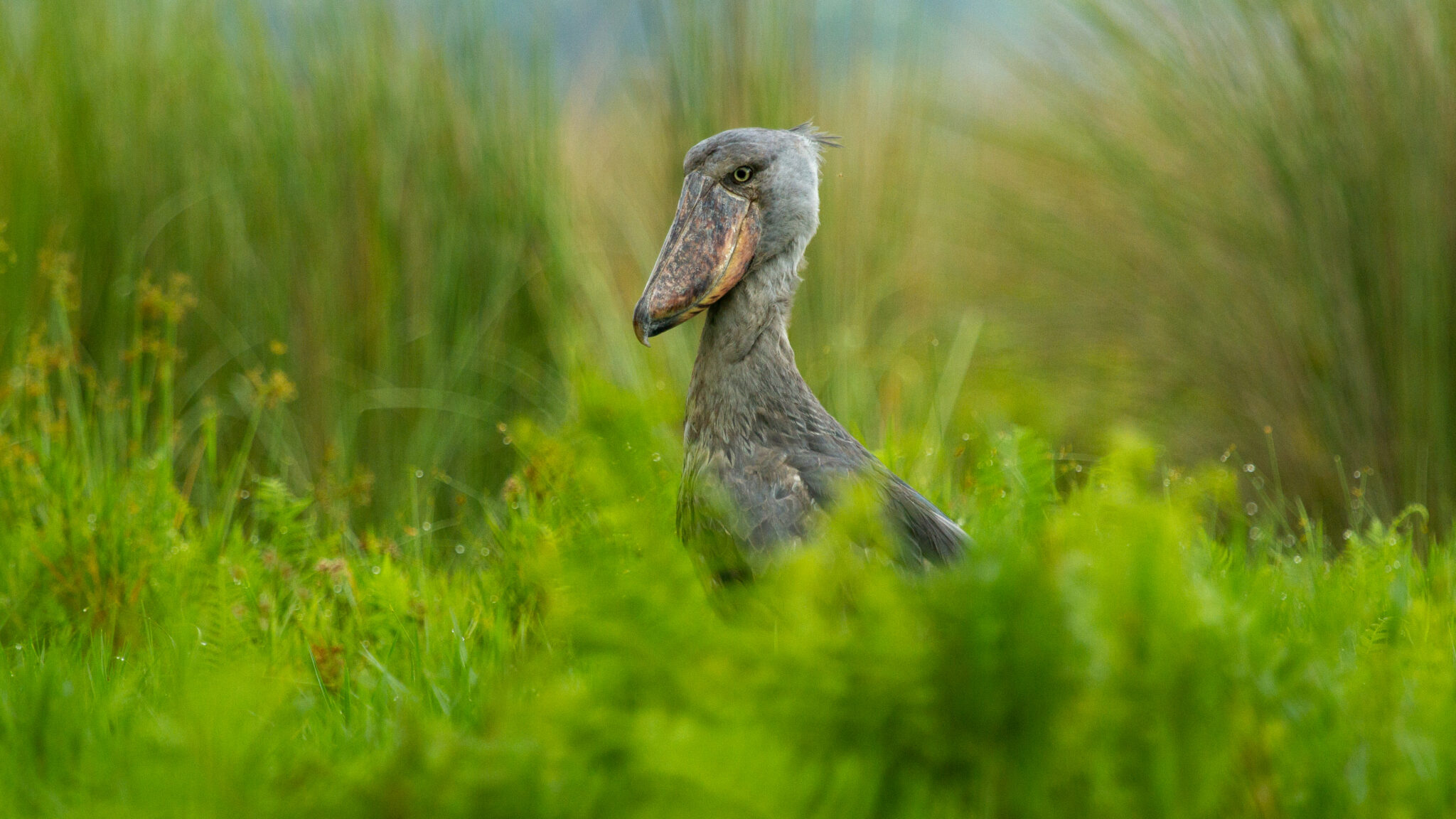
Several visits to Mabamba revealed more than a remarkable bird. They opened a window onto a living wetland, the patience of a specialist hunter, and a community whose knowledge has become central to its protection.
Into Mabamba
A Shoebill among the papyrus is the sight that draws visitors into Mabamba. I had read about this prehistoric-looking bird long before work brought me to Uganda. Mabamba Bay, on the shores of Lake Victoria near Entebbe, offered the closest opportunity: a freshwater wetland of papyrus, reeds and floating vegetation where narrow channels disappear into a seemingly endless green maze.

Reaching the swamp is part of the experience. A larger boat crosses the open water before visitors transfer to a small canoe that can move quietly through the papyrus. Finding a Shoebill is never guaranteed. The guides read the channels, vegetation and recent sightings, checking likely feeding areas without disturbing the bird.
The first encounters
On my early visits, long periods of searching ended in the thrill of finally seeing a Shoebill standing almost motionless among the floating plants. Its stillness was deceptive. Every part of the bird seemed focused on the water below.
A wait of nearly half an hour was rewarded when the bird struck and emerged with a lungfish. It carefully separated vegetation from its catch before swallowing the fish. Watching such a large bird hunt with such restraint transformed the encounter from a sighting into a study of patience.


Built for the wetland

The Shoebill’s extraordinary bill explains both its name and its hunting method. Balaeniceps rex uses the hooked tip to secure slippery prey, while long toes spread its weight across floating vegetation. It can stand almost motionless for minutes before collapsing forward in a sudden strike.
Freshwater swamps with undisturbed papyrus and reed beds provide the conditions it needs. Lungfish are a favoured prey, although the bird will also take other fish, snakes and small wetland animals. Its size and heavy bill suggest awkwardness, yet in flight it is unexpectedly graceful, soaring and gliding with ease.
Patterns, marks and colour differences on the bill vary from bird to bird. One individual carried three dark bars on the lower bill—small details that made each encounter feel personal without forgetting that these are wild birds moving through a much larger landscape.
Behaviour beyond stillness
The swamp produced surprises on later visits. On one occasion a Shoebill suddenly spread its wings and opened its bill, appearing much larger. An African Fish Eagle was overhead. The display worked: the eagle changed course. Moments like this revealed a bird that was not merely statuesque, but alert, expressive and fully capable of defending its space.
The Shoebill shares Mabamba with an entire wetland community. African Jacanas cross floating leaves on their long toes; egrets, sandpipers and fish eagles animate the channels and skies. The Shoebill may be the celebrated resident, but its survival depends on the health of this complete ecosystem.

A community and its wetland

Mabamba’s story belongs equally to its people. Local fishing families possess an intimate knowledge of the water, fish, seasons and birds. Some fishermen have become specialist bird guides, while others share information about sightings and changing conditions across the wetland.
The relationship has changed over time. Where Shoebills were once sometimes regarded as competitors for fish, conservation awareness and nature-based livelihoods have encouraged their protection. Guides, boatmen and fishermen now help visitors experience the swamp while strengthening local interest in safeguarding its most distinctive resident.
The pressures remain real: disturbance, habitat change, expanding human activity and the illegal capture of birds or chicks. Protecting Mabamba therefore means protecting both habitat and the community relationships that make conservation possible.
Returning to the Shoebill
When I returned in December 2023, the excitement had not diminished. The journey through the swamp, the quiet search and the first sight of that unmistakable profile still felt extraordinary. Familiarity had added context rather than reduced wonder: each visit revealed another detail of behaviour, another corner of the wetland and another reason to value the people who know it best.
The Shoebill draws visitors to Mabamba, but the lasting impression is broader: a rare bird, an intricate wetland and a knowledgeable community connected by the same water.
I hope many others have the opportunity to enter those papyrus channels, wait quietly and experience that relationship for themselves.